My Formal Notes have moved! See:
Formal Notes.excalidraw
or, if you are viewing this from quartz ( on my website ), then open this in a new tab. you can zoom in and out with ctrl + and ctrl - :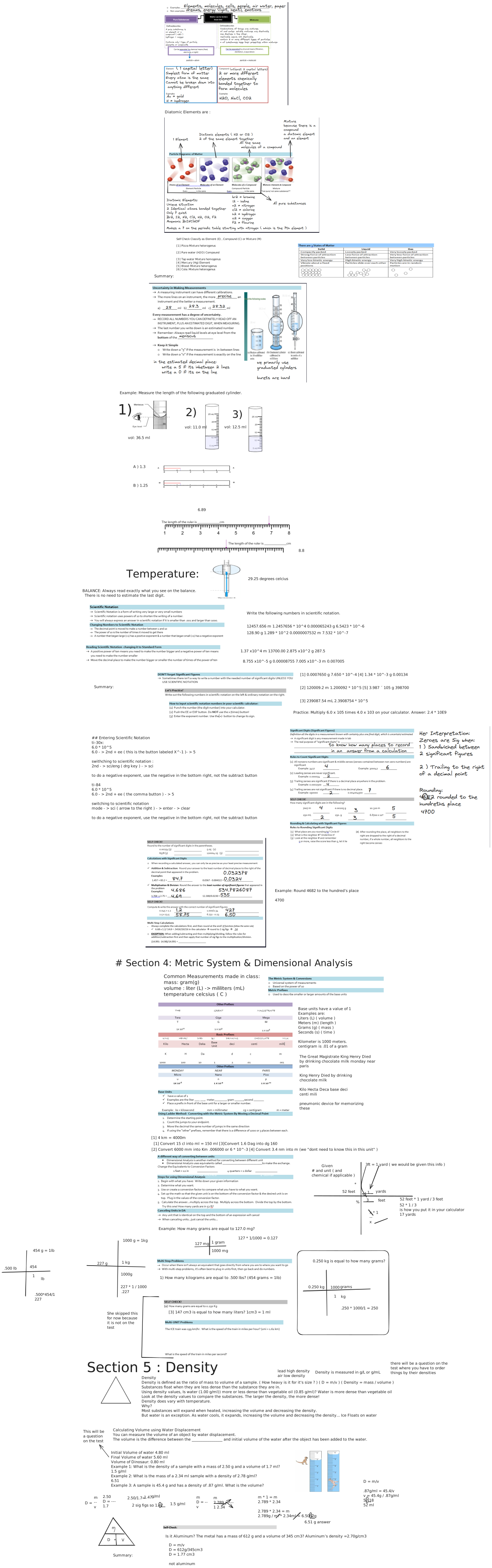
| Questions/ Vocab, etc. | Notes: What is Matter? |
|---|---|
| What is Chemistry? Study of matter: it’s composition, properties, and the changes it undergoes. An element will have One Capital letter. e.g. Gold: Au ( one capital letter ) H = hydrogen always ONE capital letter for an element. A compound will have 2 or more capital letters e.g. H2O ( H and O ) NaCl ( N and C ) ( table salt ) Element: single particle, every atom is the same | 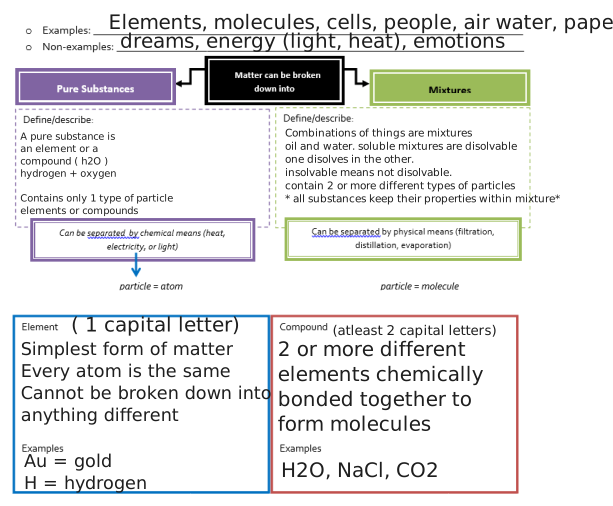 Diatomic elements are: 2 of the same element together 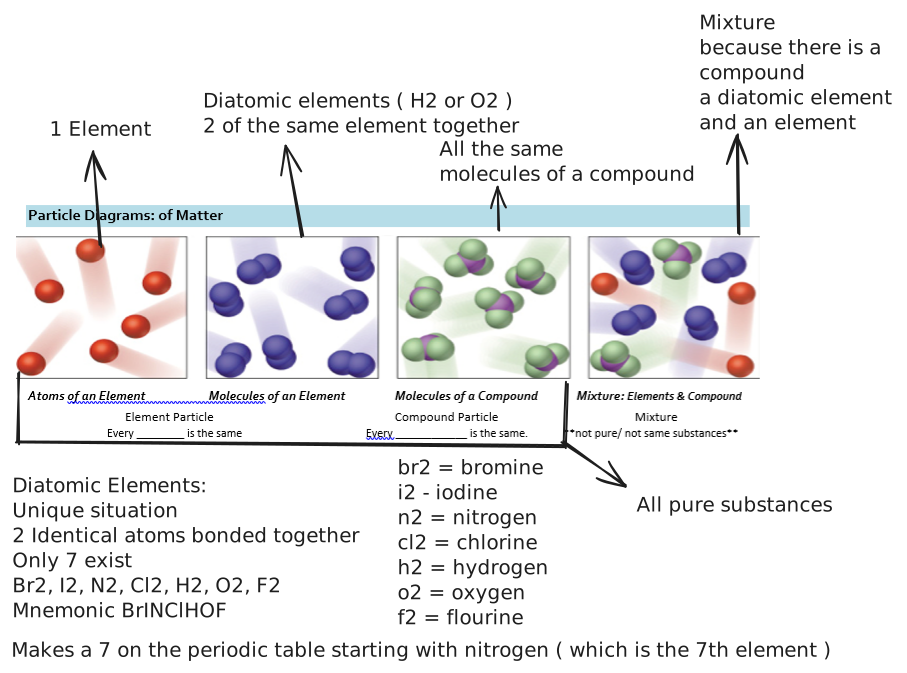 |
| Questions/ Vocab, etc. | Notes: |
|---|---|
| Homogenus - if you sample it, its uniform from top to bottom if it is heterogenus then it has layers ( think pizza) | SELF CHECK: Classify as Element (E) , Compound (C) or Mixture (M) [1] Pizza Mixture heterogenus _____ [2] Pure water (H2O) Compound [3] Tap water Mixture homogenus [4] Mercury (Hg) Element [5] Blood: Mixture heterogenus [6] Cola: Mixture heterogenus  |
a lot of gasses are diatomic like O2
Summary:
SECTION 2: Measurement & Scientific Notation
| Essential Question: |
| Questions/ Vocab, etc. | Notes |
|---|---|
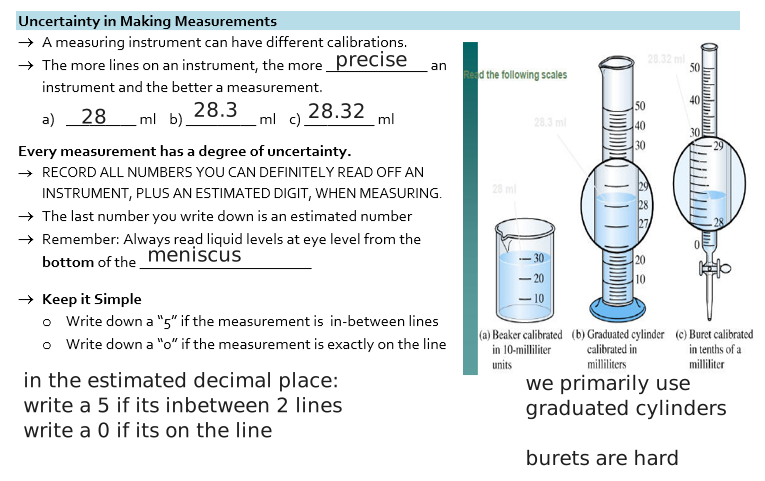 Example: Measure the length of the following graduated cylinder. The volume of the liquid in the figure to the right is : ___________ml  11.0mL 11.0mL  _12.5_mL _12.5_mLWith a ruler estimate too  a ) 1.3 b ) 1.25 | |
ruler you also estimate one place beyond where you are.
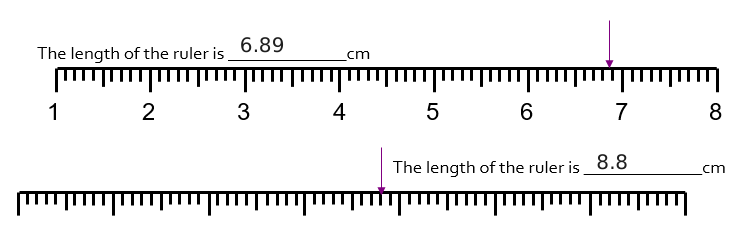  Example: YOU TRY ! Measure the temperature on the thermometer B. 29.25 for that thermometer _____________° C BALANCE: Always read exactly what you see on the balance. There is no need to estimate the last digit.  just a way to write big numbers without all the zeros. calculator can do it for you. Uses powers of 10 to shorten the writing of a number. If you have a number smaller than .001 or bigger than 1000 put it in scientific notation. Decimal point behind the first non zero number. take 300000. Move decimal point so its 3.00000. The power of 10 is the number of times the decimal point moved. so we moved 5 times for this so its 3 * 10^5. If its a number thats < 1 it has a negative exponent. If its a number > 1 it has a positive exponent. given number 12457.656 1.2457656 1.2457656 * 10^4 Write the following numbers in scientific notation. 12457.656 m 1.2457656 * 10^4 0.000065243 g 6.5423 * 10^-6 128.90 g 1.289 * 10^2 0.0000007532 m 7.532 * 10^-7  1.37 /10^4 m 13700.00 2.875 x10^2 g 287.5 8.755 x10^-5 g 0.00008755 7.005 x10^-3 m 0.007005   [1] 0.0007650 g 7.650 * 10^-4 [4] 1.34 * 10^-3 g 0.00134 [2] 120009.2 m 1.200092 * 10^5 [5] 3.987 * 10^5 g 398700 [3] 239087.54 mL 2.3908754 * 10^5  Practice: Multiply 6.0 x 10^5 times 4.0 x 10^3 on your calculator. Answer: 2.4* 10E9 |
|---|
Entering Scientific Notation
ti-30x: 6.0 * 10^5 6.0 - > 2nd + ee ( this is the button labeled X^-1 )- > 5
swithching to scientific notation : 2nd - > sci/eng ( drg key ) - > sci
to do a negative exponent, use the negative in the bottom right, not the subtract button
ti-84 6.0 * 10^5 6.0 - > 2nd + ee ( the comma button ) - > 5
switching to scientific notation mode - > sci ( arrow to the right ) - > enter - > clear
to do a negative exponent, use the negative in the bottom right, not the subtract button
Section 3: Significant Digits, Rounding & Calculating
Essential Question
| Questions/ Vocab, etc. | Notes |
|---|---|
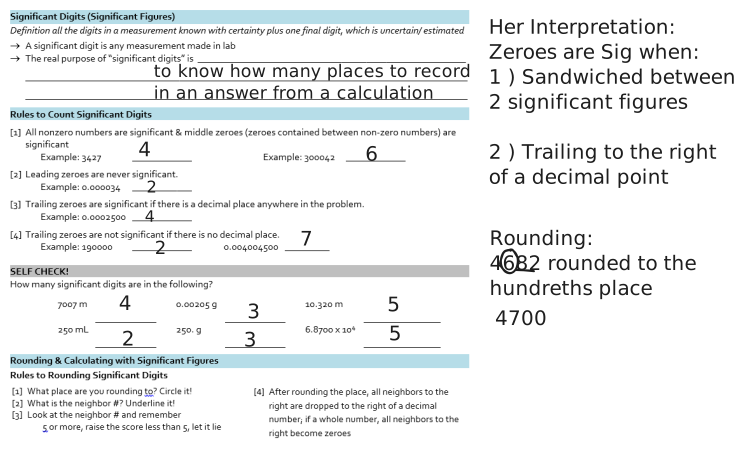 Example: Round 4682 to the hundred’s place 4700 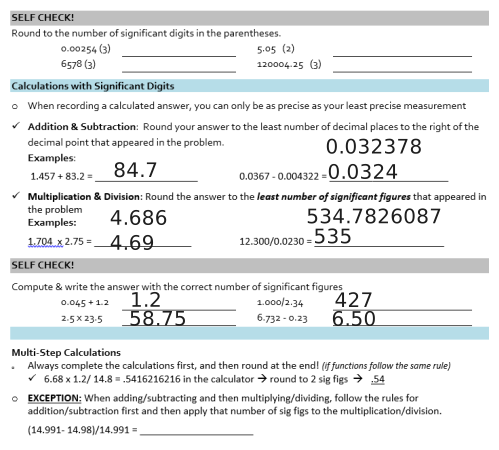 |
Section 4: Metric System & Dimensional Analysis
Essential Question
| Questions/ Vocab, etc. | Notes |
|---|---|
    [1] 4 km = ______________m  [1] Convert 15 cl into ml _____________ [3]Convert 1.6 Dag into dg ____________ [2] Convert 6000 mm into Km ____________ [4] Convert 3.4 nm into m ____________  |
Example: How many grams are equal to 127.0 mg?  1. How many kilograms are equal to .500 lbs? (454 grams = 1lb)  [3] 147 cm3 is equal to how many liters? 1cm3 = 1 ml  |
| Summary: |
Section 5: Density
| Essential Question: |
| Questions/ Vocab, etc. | Notes |
 | Density - Density is defined as the __________________ of mass to volume of a sample. - Substances ____________ when they are less dense than the substance they are in. - Using density values, Is water (1.00 g/ml)) more or less dense than vegetable oil (0.85 g/ml)? ______________ - Look at the density values to compare the substances. The larger the density, the more dense! - Density does vary with ___________. Why?Most substances will expand when heated, increasing the volume and decreasing the density. But ____________________ is an exception. As water cools, it expands, increasing the volume and decreasing the density…….. Ice Floats on water Calculating Volume using Water Displacement You can measure the volume of an object by water displacement. The volume is the difference between the ________________ and initial volume of the water after the object has been added to the water.  Initial Volume of water Final Volume of water ___________ Volume of Dinosaur: _______ Example 1: What is the density of a sample with a mass of 2.50 g and a volume of 1.7 ml? Example 2: What is the mass of a 2.34 ml sample with a density of 2.78 g/ml? Example 3: A sample is 45.4 g and has a density of .87 g/ml. What is the volume?  Is it Aluminum? The metal has a mass of 612 g and a volume of 345 cm3? Aluminum’s density =2.70g/cm3 Is it Aluminum? The metal has a mass of 612 g and a volume of 345 cm3? Aluminum’s density =2.70g/cm3 |
| Summary: |